Swedes Fined After Stones Are Thrown Across the Norway Russia Border
Three Swedish citizens were fined after a minor act at Grense Jakobselv became a serious border matter in one of Europe’s most sensitive northern regions.
Three Swedish citizens were fined after throwing stones from Norway across the border into Russia, an act that Norwegian police treated as a formal border violation (överträdelse) rather than a harmless tourist mistake. The incident happened on Thursday afternoon at Grense Jakobselv in Finnmark, where Norway’s far northeastern landscape meets Russian territory across a narrow river. Each of the three Swedes was ordered to pay NOK eight thousand, showing how even a small physical gesture can carry legal consequences in a tightly controlled border zone.
Police in Finnmark said they were alerted by the Norwegian Armed Forces on Thursday evening after the act was observed near the border. The area is not only a scenic destination but also a monitored frontier (gräns) between Norway and Russia, two countries whose northern relationship has become more sensitive since Russia’s full scale invasion of Ukraine. Although no one was injured and the incident did not involve weapons, the act crossed a clear legal line because objects were thrown from one country into another.
Grense Jakobselv lies about an hour by car from Kirkenes and attracts locals, road travellers, and visitors curious to see one of the most unusual border areas in northern Europe. In several places, the road runs very close to the boundary (gränslinje) itself, with only a small river separating Norwegian ground from Russian land. This closeness can make the place feel deceptively informal, but Norwegian authorities repeatedly remind visitors that the border is not symbolic scenery. It is an international state border governed by strict rules.
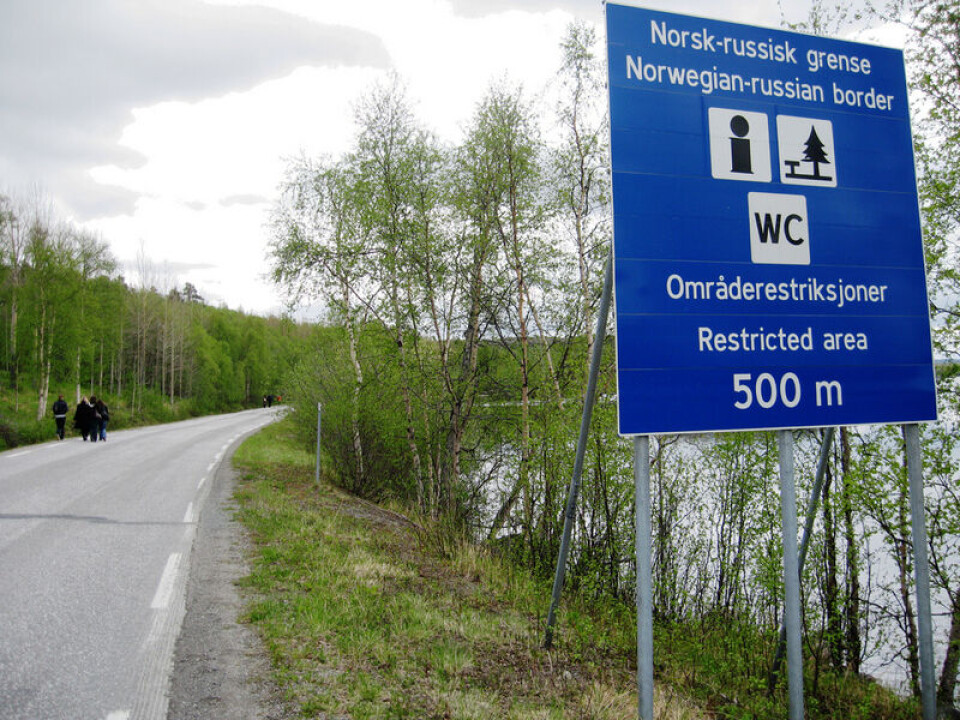
Norway’s border with Russia stretches for roughly one hundred and ninety eight kilometres through Arctic terrain, rivers, forests, and remote settlements. The Norwegian police and military border guards maintain surveillance (övervakning) across the area, while Russian authorities monitor the opposite side. At some points the distance between the road and the border is only a few metres, which means tourists can make a serious legal mistake very quickly. Signs posted in the area warn people about what they may and may not do.
The rules along the Norwegian Russian border prohibit crossing the border by land, water, or air except at approved points. They also forbid contact with people on the other side, conversations across the border, and acts that may be considered threatening or intimidating (hotfulla) toward the neighbouring state. Throwing stones falls into that category because it is an action directed across the border, even if the people involved claim they did not intend political harm. The law treats the direction of the act seriously.
The police have also warned visitors not to photograph Russian military personnel or Russian defence equipment from Norwegian territory. This rule reflects the military sensitivity (känslighet) of the region, where civilian tourism exists beside a highly controlled security environment. Many visitors arrive expecting dramatic Arctic views, an isolated chapel, and a road that reaches the Barents Sea. What they also find is a border where behaviour that might seem casual elsewhere is interpreted through the lens of national security.
This was not the first time stone throwing across the same border led to fines. In two thousand sixteen, four Norwegians were fined after a similar infraction (förseelse) at the border with Russia. That earlier case drew attention in Russian national media, showing how even minor episodes at this frontier can become part of a wider political conversation. The latest case involving Swedish citizens has again been reported beyond Norway, partly because the border is symbolically important in the current European security climate.
The case also follows other border trouble involving Swedes in Finnmark. In May, a Swedish citizen was apprehended (gripen) after an illegal border crossing near the Norwegian Russian border. High North News described Swedish border violations as not uncommon, although serious crossings remain relatively rare. The pattern is important because it shows that the border is not only a geopolitical line on a map. It is also a place where tourists, residents, and travellers sometimes misjudge the seriousness of local restrictions.
Norwegian authorities have long tried to make the rules visible and understandable to visitors. Signs along the road explain that people must keep a safe distance and avoid conduct that could cause undesirable incidents (incidenter). At Grense Jakobselv, the natural landscape can create a false sense of openness. There may be no high wall on the Norwegian side, and the river can appear narrow or shallow, but the absence of dramatic physical barriers does not mean the border is relaxed or negotiable.
On the Russian side, the security environment is much more physically marked. Barbed wire fencing and restricted zones limit civilian access, while border guards monitor movement near the line. This contrast creates a strange juxtaposition (sammanställning): Norway’s side can look open, quiet, and scenic, while the Russian side is visibly controlled. Visitors standing in Norway may therefore feel close to Russia, but legally and politically they are still separated by one of NATO’s most watched northern borders.
The role of Norwegian conscripts adds another layer to the story. NATO has described this as the alliance’s northernmost border with Russia, guarded by Norwegian Army conscripts (värnpliktiga) who operate in Arctic darkness, heavy snow, and extreme cold. Their work is not limited to watching from a distance. They patrol by ski and snowmobile, observe unusual activity, and help maintain a continuous Norwegian presence in a strategically important region. In that context, even small acts can trigger an official response.
The border has gained renewed importance since twenty twenty two, when Russia’s war against Ukraine reshaped European security thinking. Norway, as a NATO member, has become more alert to illegal crossings, military activity, and the possibility of pressure at northern border points. The Storskog checkpoint remains the official crossing between Norway and Russia in the area, but authorities have also considered stronger physical deterrence (avskräckning) around exposed sections. Their goal is to prevent confusion, unsafe movement, and deliberate attempts to exploit the terrain.
The location itself is unusually remote (avlägsen), but it is not ignored. Grense Jakobselv is watched precisely because its geography is easy to misunderstand. A road, a small river, forest, stones, and a view across the water may look like a quiet rural scene. Yet the same place is also a legal border between Schengen Europe and Russia, between NATO territory and a neighbouring state now viewed with much greater caution by Western governments.
Key Swedish Vocabulary
överträdelse violation
gräns frontier
gränslinje boundary
övervakning surveillance
hotfulla intimidating
känslighet sensitivity
förseelse infraction
gripen apprehended
incidenter incidents
sammanställning juxtaposition
värnpliktiga conscripts
avskräckning deterrence
avlägsen remote
For requests or suggestions: pr@learnsvenska.org
Learn the official language of Sweden in 30 days thanks to the most complete Grammar, Vocabulary and Culture courses available. Start speaking Swedish today!

Land of the Midnight Sun

© 2026 All rights reserved
