
Sweden Returns to Books as Schools Rethink Digital Learning
After years of promoting screens in classrooms, Sweden is now turning back to printed books and handwriting to improve literacy and concentration.
Sweden, long seen as one of Europe’s most digitally advanced societies, is now moving in a more analogue (analog) direction inside its classrooms. The government wants schools to place greater emphasis on printed textbooks, handwritten notes, paper exercises, and traditional reading habits. This change is intended to respond to concerns about falling literacy levels and weaker concentration among pupils. For many years, Swedish education was associated with laptops, tablets, digital platforms, and early technological independence. Now, however, politicians and some researchers argue that the country may have moved too far, too quickly, toward screens.
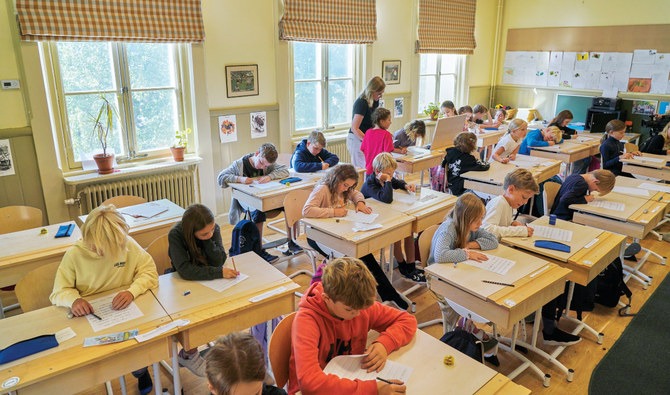
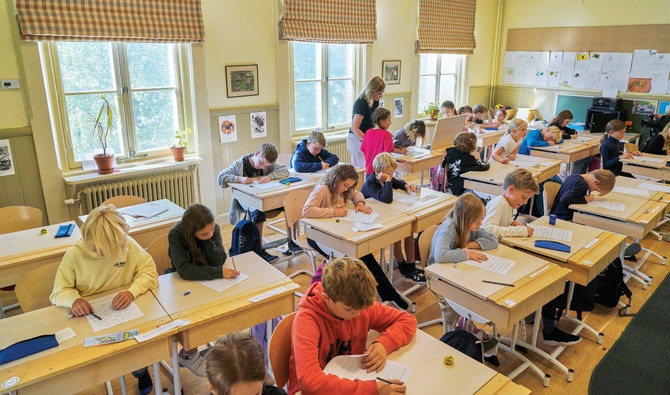
At a high school in Nacka, near Stockholm, students describe a school environment that looks different from the one they knew only a few years ago. Laptops are still visible, but books, worksheets, and printed texts have returned to daily lessons. Some teachers now print reading materials instead of asking pupils to read everything on a screen. In mathematics, digital learning tools have in some cases been replaced by textbooks. For students who grew up with constant access to online platforms, this return to paper can feel like a reversal (omvändning) of Sweden’s earlier educational direction.
The shift is striking because Sweden has a strong reputation for technological confidence. The country has produced major digital companies, has high levels of internet access, and is often described as comfortable with innovation. In schools, laptops became common during the late 2000s and early 2010s. By the middle of the last decade, many high school students in municipal schools already had their own digital device. In 2019, even preschool curricula included the use of tablets as part of preparing children for a digital society. That earlier policy reflected a belief that digital skills should begin early.
The current government has taken a different position. It argues that younger children especially should spend far less time using screens during school hours. Political supporters of the change say pupils need to develop basic reading, writing, and counting skills before digital tools become central to learning. The government has promoted the Swedish slogan “från skärm till pärm,” meaning from screen to binder. The phrase captures a broader pedagogical (pedagogisk) change: children should first learn through books, pencils, paper, and direct teacher guidance, rather than through constant digital interaction.
Supporters of this approach believe screens can make it harder for pupils to focus. In a classroom where many children have devices open, a student may become distracted not only by their own screen but also by what classmates are doing. Notifications, games, videos, web searches, and unrelated tabs can all interrupt attention. Even when digital tools are meant for schoolwork, they may create a less calm learning environment. For younger pupils, who are still developing self control and reading habits, these interruptions may be especially disruptive (störande).
The Swedish government hopes that more traditional teaching methods will help improve reading results. International comparisons have shown that Sweden is no longer the top performer it once was. Its results in reading and mathematics declined sharply in 2012, recovered for a period, and then fell again in 2022. Although Swedish pupils still performed slightly above the OECD average, the country’s literacy results were weaker than those of several comparable nations. Almost one quarter of Swedish students aged fifteen or sixteen did not reach a basic level of reading comprehension, a figure that has increased pressure for reform.
Researchers who support a more cautious use of technology point to evidence that reading on paper and reading on screens do not always produce the same results. Some studies suggest that pupils may understand and remember complex texts better when they read them physically. Paper can make it easier to slow down, underline, reread, and build a mental map of a text. Screens, by contrast, often encourage faster scrolling and more fragmented attention. This does not mean digital reading is useless, but it does suggest that physical books may offer important cognitive (kognitiva) advantages.
Since 2025, Swedish preschools are no longer required to use digital tools, and tablets are not supposed to be given to children under the age of two. A ban on mobile phones in schools is also planned, including cases where phones might otherwise be used for educational purposes. At the same time, the government has allocated more than two billion kronor to help schools buy textbooks and teacher guides. A new curriculum, expected in 2028, is intended to strengthen textbook based learning. These measures show that the policy is not symbolic, but part of a wider curriculum (läroplan) reform.
However, the move away from screens has not been welcomed by everyone. Technology companies, education specialists, and computer scientists have warned that Sweden risks weakening the digital skills of future workers. Their argument is not that children should spend all day on devices, but that schools must prepare pupils for the world they will enter after graduation. Almost every modern profession now requires some ability to use digital systems, search for information, evaluate online sources, communicate through software, or work with automated tools. If schools overcorrect, critics fear that pupils may become less employable (anställningsbara).
The Swedish Edtech Industry association has been especially critical of the government’s direction. Its representatives argue that the debate has become too simple, as if schools must choose either books or computers. In their view, the real question should be how digital tools are used, when they are useful, and whether teachers have the training to integrate them well. A poorly designed digital lesson may distract pupils, but a well designed one can support learning, creativity, accessibility, and collaboration. The challenge is therefore not simply digital versus analogue, but effective versus ineffective implementation (genomförande).
This debate also matters for Sweden’s economy. The country has become known for producing successful technology companies, including firms in music streaming, artificial intelligence, gaming, financial technology, and legal software. Critics of the school reforms warn that Sweden’s start up culture depends on a workforce with strong digital confidence. If young people leave school without enough technical experience, companies may struggle to find skilled employees. In the long term, some business leaders fear that innovation could move elsewhere, weakening Sweden’s international competitiveness (konkurrenskraft).
Artificial intelligence has added another layer to the discussion. The government wants older students to learn about the opportunities and risks of AI, but some educators argue that younger pupils also need age appropriate exposure. Their concern is that children from wealthier or more digitally confident families will learn how to use AI tools at home, while others may be left behind. This could create a new inequality (ojämlikhet) between pupils who understand digital systems and those who do not. In that sense, removing technology from early education could unintentionally widen the gap it is meant to close.
Supporters of the government’s policy reject that criticism. They argue that proper education begins with strong foundations: reading fluently, writing clearly, thinking logically, and understanding numbers. Without those skills, pupils may use technology without really understanding what they are doing. From this perspective, screens should not replace basic learning, especially for younger children. A child who cannot read confidently may struggle even more in a digital environment full of links, menus, pop ups, and quick distractions. For these supporters, books and paper are not old fashioned objects but tools for building foundational (grundläggande) knowledge.
The disagreement in Sweden is therefore not only about devices. It is about what kind of education best prepares children for the future. One side believes that schools must protect attention, reading depth, and basic skills from excessive screen use. The other side believes that digital competence is itself a basic skill and should not be pushed too far into later education. Both sides agree that learning matters, but they differ on whether screens are mainly a problem to be controlled or a tool to be improved. This makes the debate unusually polarised (polariserad).
Students themselves are divided. Some older pupils say younger children should not use digital tools as heavily as their generation did, because the internet can make it harder to concentrate. Others argue that computers are part of real life and should remain central in education. Their views reflect the larger national conversation. Swedish classrooms are trying to find a balance between the quiet focus of books and the practical reality of a digital world. The final answer may not be a complete return to the past, but a more careful decision about when technology truly helps learning and when it gets in the way.
Sweden’s experiment will be watched closely by other countries. Many education systems are asking similar questions about phones, tablets, online platforms, reading skills, and artificial intelligence. Sweden is unusual because it embraced digital learning early and is now publicly correcting course. If the return to books improves literacy and concentration, other governments may follow. If it weakens digital readiness, critics will point to Sweden as a warning. For now, the country is testing a difficult compromise (kompromiss): giving children the benefits of modern technology without allowing screens to dominate the classroom.
Key Swedish Vocabulary
analog analogue
omvändning reversal
pedagogisk pedagogical
störande disruptive
kognitiva cognitive
läroplan curriculum
anställningsbara employable
genomförande implementation
konkurrenskraft competitiveness
ojämlikhet inequality
grundläggande foundational
polariserad polarised
kompromiss compromise
For requests or suggestions: pr@learnsvenska.org
Learn the official language of Sweden in 30 days thanks to the most complete Grammar, Vocabulary and Culture courses available. Start speaking Swedish today!

Land of the Midnight Sun

© 2026 All rights reserved
