
Sweden Celebrates Fifty Years of King Carl XVI Gustaf and Queen Silvia’s Marriage
The royal couple’s golden wedding anniversary brings together family, music, ceremony, memory, and public celebration in the heart of Stockholm.
Sweden is celebrating fifty years of marriage between King Carl XVI Gustaf and Queen Silvia, a royal jubilee (jubileum) that connects the present day with one of the most memorable Swedish weddings of the twentieth century. The couple married on June nineteen, nineteen seventy six, in Stockholm Cathedral in the Old Town, only a few years after Carl Gustaf had become king. Half a century later, their anniversary is being marked not only as a private family milestone, but also as a public moment in Swedish royal history.
The actual wedding anniversary falls on June nineteen this year, but because that date is Midsummer Eve, the main celebration has been moved forward to June thirteen. This gives Stockholm a separate day for royal festivities (festligheter) before the country turns its attention to one of its most important summer traditions. The programme includes a church service, a ceremonial journey on the water, a carriage procession through the city, an open concert, and an evening performance at the Royal Opera.
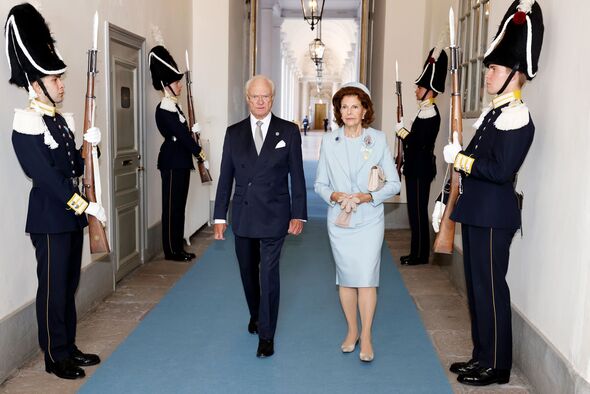
The day begins with a Te Deum in the Palace Church, a traditional royal thanksgiving service used for major moments in the life of the Swedish royal family. The service gives the anniversary a solemn liturgical (liturgisk) beginning before the celebrations move into the streets of Stockholm. The entire royal family is expected to attend, together with invited guests from neighbouring royal houses and senior representatives of the Swedish state, including government and parliamentary figures.
Among the guests are Norway’s King Harald and Queen Sonja, Princess Benedikte of Denmark, Prime Minister Ulf Kristersson, Speaker Andreas Norlén, and other Swedish officials. Their presence gives the anniversary a strong Nordic and institutional dimension (dimension). The celebration is therefore not only about the marriage of two people, but also about continuity, friendship between royal houses, and the role of the monarchy in Swedish public life.
In the afternoon, the King and Queen travel by the royal sloop Vasaorden across Stockholm’s waterways, echoing the journey they made on their wedding day in nineteen seventy six. The historic sloop (slup) is strongly associated with royal ceremonial life and gives the celebration a visual link to the past. Water has always been central to Stockholm’s identity, and the sight of the royal couple moving across the city by boat makes the anniversary feel closely tied to the capital itself.
After the journey on the water, the celebration continues with a horse drawn carriage procession through central Stockholm. The royal cortège (kortege) follows a route from Djurgården through some of the city’s best known streets before arriving at Kungsträdgården. For spectators, the procession offers a rare chance to see the King and Queen at close range in a public setting. For the royal couple, it recreates the atmosphere of their wedding day while also inviting a new generation into the memory.
The procession ends in Kungsträdgården, where the City of Stockholm is arranging an open concert “in the name of love.” The musical repertoire (repertoar) spans the fifty years of the King and Queen’s marriage, connecting private memory with public culture. Artists announced for the concert include Eah Jé, Eric Gadd, Grymlings, Jill Johnson, Lina Hedlund, Sabina Ddumba, and Tensta Gospel Choir. The event is open to the public, making the anniversary a city celebration rather than only a court ceremony.
The choice of Kungsträdgården is symbolic because the park is one of Stockholm’s most familiar public gathering places. Concerts, festivals, demonstrations, seasonal events, and spontaneous meetings have long made it a civic thoroughfare (genomfartsplats) as well as a cultural space. By ending the public procession there, the celebration moves from palace and ceremony into the shared urban life of Stockholm. The city itself becomes part of the anniversary, not merely a backdrop.
Later in the evening, the festivities conclude with a golden wedding concert at the Royal Opera. This setting creates a powerful circularity (cirkularitet) because the opera was also central to the couple’s wedding story in nineteen seventy six. On the night before their wedding, a gala was held there, and ABBA performed “Dancing Queen” publicly for the first time. The song became inseparable from the memory of the young king, his future queen, and Sweden’s place in global pop culture.
Another famous moment from that nineteen seventy six gala involved singer and actress Kjerstin Dellert, who performed the revue couplet “O, min Carl Gustaf.” The performance reportedly made the King laugh and blush, adding a moment of theatrical mischief (busighet) to an otherwise formal royal occasion. That mixture of ceremony and warmth is part of why the wedding still has such a strong place in Swedish cultural memory. It was grand, but it also felt human.
Queen Silvia, born Silvia Sommerlath, met Carl Gustaf at the Munich Olympic Games in nineteen seventy two, before he became one of Europe’s longest reigning monarchs. Their relationship grew during a period of great public attention, and her arrival in Sweden brought a new international sensibility (känsla) to the royal family. She had a multilingual background and professional experience connected to international events, which later shaped her public work as queen, especially in areas involving children, dementia, disability, and social welfare.
Over fifty years, the royal couple have lived through major changes in Sweden and in the monarchy itself. Their marriage has seen shifts in media culture, public expectations, gender roles, family life, and the relationship between royalty and citizens. In that changing environment, their partnership has become a symbol of endurance (uthållighet). The anniversary therefore looks backward to the wedding, but it also reflects the long public life they have shared through decades of national ceremonies, state visits, family milestones, and public duties.
The King and Queen’s family has also grown during those five decades. Crown Princess Victoria, Prince Carl Philip, and Princess Madeleine have all built their own families, making the golden wedding anniversary a celebration that includes children and grandchildren. This gives the day a generational resonance (genklang). The royal couple are not only being celebrated as monarch and queen, but also as parents and grandparents whose marriage has become part of the wider story of the Swedish royal house.
The anniversary has also been accompanied by exhibitions and public interest in objects connected to the nineteen seventy six wedding. Photographs, clothes, gifts, and ceremonial items help turn private history into a national retrospective (tillbakablick). Such displays allow visitors to see how the wedding was presented at the time, how fashion and design reflected the period, and how the image of the royal couple has developed across half a century. The past becomes something people can view, compare, and reinterpret.
Although royal anniversaries are often filled with tradition, this celebration also shows how monarchy adapts to modern public expectations. The day combines church ritual, royal vehicles, official guests, live music, public access, television coverage, and city participation. That blend creates a careful juxtaposition (sammanställning) of old and new. The Vasaorden and the carriage procession recall older ceremonial forms, while the open concert and popular artists make the event feel contemporary and accessible.
The anniversary is especially meaningful because it celebrates a relationship that has lasted through the pressures of public life. Royal marriages are never entirely private, and every public appearance becomes part of a larger national narrative. Yet the golden wedding celebration focuses on affection, memory, and shared time. Its central motif (motiv) is love, but the event also carries themes of duty, continuity, family, and Sweden’s ability to combine formality with openness.
For many people in Stockholm, the most memorable part of the day may not be the official guest list or the evening concert, but the chance to stand along the route and take part in a collective celebration. Waving crowds, music in Kungsträdgården, and the movement of the royal carriage through the city create a sense of public participation (deltagande). The anniversary belongs to the royal couple, but the celebration is designed to let ordinary citizens share in the moment.
Fifty years after the wedding in Stockholm Cathedral, King Carl XVI Gustaf and Queen Silvia’s golden anniversary closes a circle that began with a young king, a new queen, a gala at the opera, and a song that became legendary. The celebration on June thirteen brings those memories back into the city, but it also places them in a present marked by family, history, and public affection. In that sense, the day is more than royal commemoration (högtidlighållande). It is a living reminder of how personal stories can become part of a country’s shared memory.
Key Swedish Vocabulary
jubileum jubilee
festligheter festivities
liturgisk liturgical
dimension dimension
slup sloop
kortege cortège
repertoar repertoire
genomfartsplats thoroughfare
cirkularitet circularity
busighet mischief
känsla sensibility
uthållighet endurance
genklang resonance
tillbakablick retrospective
sammanställning juxtaposition
motiv motif
deltagande participation
högtidlighållande commemoration
For requests or suggestions: pr@learnsvenska.org
Learn the official language of Sweden in 30 days thanks to the most complete Grammar, Vocabulary and Culture courses available. Start speaking Swedish today!

Land of the Midnight Sun

© 2026 All rights reserved
